
Not a duo — we just have matching outfits
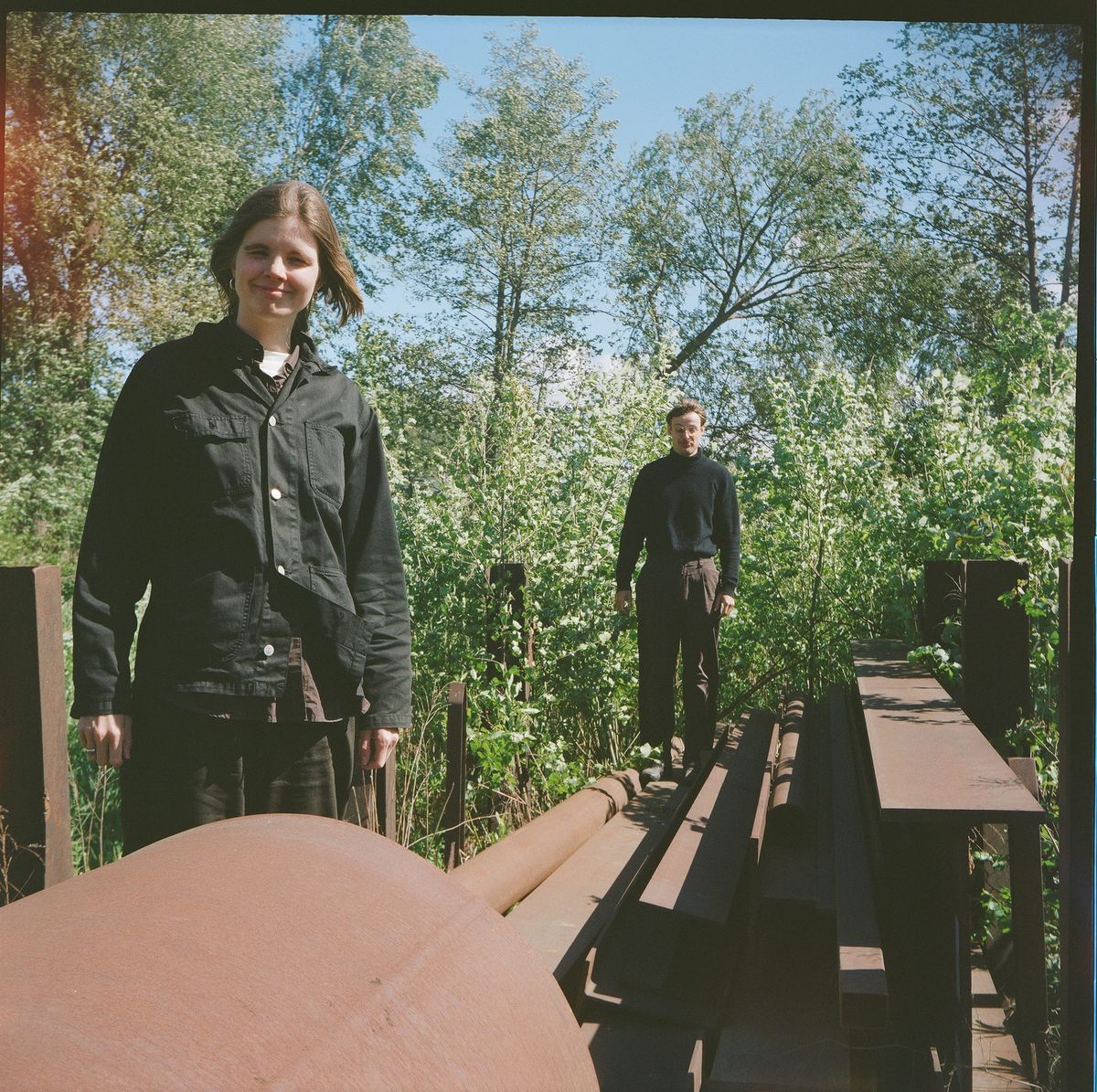
APARAAT APART — Studio Visit
Krišjānis Beļavskis & Johanna Sandels
Krišjānis Beļavskis works across sculpture, installation and text, circling around labour, value and authorship. He describes his approach as parasitical — less as critique, and more as a way of latching onto existing systems and seeing what they give back. In one project, he invited someone to sit in his studio and watch him work, paying them the Latvian average hourly wage. In another, he auctioned off five future workdays on a USB stick, neatly packaging time as something you could own.
Johanna Sandels is a sound artist composing with field recordings, self-built VLF antennas, and handmade instruments. Her practice focuses on resonance, overtones, and the textures of sound shaped by improvisation and changing environments. It gravitates around the Swedish concept väsen — a word meaning simultaneously: essence, noise, collective being, creatures from folklore, tumult.
They are a couple based between Riga and Stockholm. This conversation took place in Riga.
Do these descriptions accurately describe your practices?
Krišjānis: More or less what I have on my website.
Interviewer: Something you actually wrote yourself?
Krišjānis: Yes, roughly. I have portfolios online and the description was drawn from those.
Are you a duo? I was at your show, but I think that was the only time you actually worked together.
Krišjānis: Not a duo. We just have matching outfits today.
Johanna: Sometimes we might not be a duo, but we do talk to each other constantly. Now that I'm building a speaker, he's involved in that too.
Krišjānis: I help out. We do our separate things most of the time — it's technical assistance, not collaboration.
Your practices are very different, yet you contribute to each other's work.
Krišjānis: We each have our own ideas. It's mostly technical help — she helped me with sound once, and with video. I had a show at the Dome Gallery and didn't want a straightforward opening, so Johanna played music.
Johanna: I made a concert for the opening, but the works were Krišjānis's.
Interviewer: I thought one piece was jointly made.
Johanna: Close, but not quite. The rock he filmed was in Sweden — I'd shown him this place in a forest. There's a rock with what looks like a perfectly even crack running through it, as though lightning had passed through.
Krišjānis: About two centimetres wide, running straight down the face of a rock. And there was also a story Johanna had told me — about trolls living inside rocks with keys.
Johanna: Particularly in that part of Sweden. When I was small, my grandparents had a cabinet with keys and they'd tell me: these go to the troll's rock. The idea of keys that unlock rocks.
Krišjānis: I took that idea into the exhibition.
Your mediums are quite different — Johanna works with audio, a diffuse and often ambiguous spectrum of perception, whereas Krišjānis you work primarily with the visual, which is more concrete. Sound can be misread.
Johanna: Yes — and I prefer it that way. I'm drawn to things that are a little diffused. I look at how sound is made and how it travels, whereas Krišjānis tends toward the concrete.
The idea of the troll in the rock seems to extend into your work, Johanna — using technology to suggest a world that's rich and mysterious, full of things we can't immediately perceive. Does that come from somewhere deep in your culture?
Johanna: There's a great deal of folklore about the forest and the beings in it. But I also like exposing the limits of technology. When I made the VLF antenna to try to record the Northern Lights, I kept things deliberately ambiguous — showing how it doesn't quite work, or works strangely, leaving space for not knowing. Today we assume technology can capture everything, that everything is translatable into data. I want to challenge that. Väsen resists that reduction. Some things are too layered with interpretation to become ones and zeros.
Krišjānis, what is your relationship to technology?
Krišjānis: I don't use it much. The speaker project is the closest I've come — and that came through Johanna. At the time she was still studying in France, doing sound workshops. My access to the technical has mostly been through her work.
Johanna: I know some of it, but I'm still relatively new to it. The speaker would not have been possible without collaborating with others — Sven, and in the early stages Oto and Krišjānis helped with the first wooden prototype. The technical measurements are Sven's domain. There's also Ingmar, an older Swedish acoustician who's been advising.
— The Antenna —
Tell me about building the VLF antenna.
Johanna: I'd read research by a Finnish scientist, Unto K. Leine, who had been investigating whether the Northern Lights produce sound. He had a professional, expensive setup — a very low frequency antenna and microphones. I thought I could make a simpler version and just try. I found a sound artist's guide online. All you need is copper wire wound around a bicycle wheel in a circle — a specific length — then you solder the ends and connect via a jack to a Zoom recorder. It picks up electromagnetic signals.
According to Leine, these signals are linked to the Northern Lights. But when I got to Tromsø to record, I spoke to a physicist at the Northern Light Centre who said he didn't believe Leine's research at all — that you couldn't capture the sound that way.
Interviewer: What was his objection?
Johanna: Simply that he didn't believe the method worked. And I found it quite poetic to keep working with the antenna anyway — to record sounds without knowing exactly what they were. Rather than trying to prove or disprove anything, I made the uncertainty the work itself.
Interviewer: At one point this whole territory became fashionable — Northern Lights sounds, VLF recording. But you were working with it before that.
Johanna: Yes. And there are accounts of people hearing the Northern Lights without any equipment at all — very faint sounds that appear only in very cold conditions when the aurora is active.
Krišjānis: I like that you brought people on this expedition to listen to something that might not exist. Up a mountain, in winter.
Johanna: I invited people for a sound walk to the place where I'd been recording. One person at a time would listen through headphones, then pass them on. Nobody knew what they were hearing, and they struggled to describe it. Something like tick, tick, tick.
— Language & Territory —
You met, and now Krišjānis speaks Swedish.
Krišjānis: Mere eller mindre.
[More or less.]
Interviewer: And Johanna speaks Latvian.
Johanna: Protams.
[Of course.]
And Krišjānis has decided to occupy part of Latvia — the historical Swedish part.
Krišjānis: Old Sweden.
Johanna: He's annexing it.
Elgaland-Vargaland — can you explain?
Krišjānis: These are artists who do annexations. Johanna introduced me to them — I was looking for an internship in Sweden and the obvious gallery options all seemed dull. She knew Carl Michael von Hausswolff. Back in the nineties, he and Leif Elggren founded this state, this kingdom.
Interviewer: A kingdom with laws, a constitution, a flag.
Johanna: Two kings.
Krišjānis: Stamps, passports — we got ours yesterday. There's an application form; you sign it and a proper passport arrives. I thought about how to make my time there more than just an internship, so I proposed a collaboration around a specific border — the historical frontier between the Swedish Empire and the Polish-Lithuanian Commonwealth, from the 1600s. That border runs five kilometres from where I grew up. My father is a local history enthusiast; he spends time in those forests looking for traces of it. I thought Elgaland-Vargaland might want to formally annex it.
Interviewer: So you're claiming a piece of Latvia.
Krišjānis: Historical Swedish land, technically. We'll apply for funding in the autumn.
Interviewer: Three kings?
Krišjānis: I'm only a citizen. Though one can also become an ambassador — they have consulates across every continent.
Johanna: They make it into performance sometimes. Rituals, ceremonies, diplomatic relations. They submitted an application to the United Nations — they went to New York to try to join as a member state.
Interviewer: So this is political critique — flirting with anarchism.
Krišjānis: I find it funny more than anything. I don't think they have a rigid agenda, and that's part of what I like about it. We'll try to involve students in the border annexation event — it can be genuinely playful.
— Resonance & Collaboration —
One more thing — resonance triggers resonance. You can transfer that concept to relationships. Do you feel you resonate with each other?
Johanna: The people around you always shape how you think. What I believe and how I see things is probably very much the product of those close to me. I don't believe in originality, not in the absolute sense. People are always affecting each other, and that's the good part.
Johanna, can you tell me about the Copenhagen water tower installation?
Johanna: It's a sound installation in a water tower this autumn. I want to work with the echo of the space — the timing, the way sound bounces — so the echo becomes part of the composition itself. You lose track of where the source is.
Interviewer: A loop.
Johanna: In a sense. I tend to invite something or someone that removes some of my control. For a concert in Tromsø accompanying silent films, I invited Maurice and Okko Collective — two friends who sing Eastern European folk songs. I make electronic music. Something happens between the two that I couldn't produce alone. When you're two or three people, there's a fourth thing: what you make together.
The Swedish sense of community and collective work — do you feel Krišjānis has a different relationship to that? Many Latvians of the older generation carry a deep ambivalence about collective endeavour, shaped by the Soviet experience.
Johanna: What I notice is that Krišjānis loves group exhibitions — but within them, he always has his own work. The collective is the context, not the method.
Krišjānis: I've never made anything truly collaborative. I've always made work alone, or given help, or received it — never something where the authorship is genuinely shared.
Johanna: You had an assistant once. But that's not collaboration — someone helped execute your idea.
Krišjānis: What is collaboration, really? I do think it matters to be around people who are making things. That's not the same as working together in the full sense. And even solo, the thinking was never completely isolated.
— The Speaker —
What are you each working on now?
Johanna: The omnidirectional speaker. I want a concert where the sound is circular — no stage, no frontal projection. The speaker becomes a character in itself. Partly because I think it would free the performer from needing stage presence. You put the speaker out and let it be.
Krišjānis: What I like is the instrument-as-protagonist idea — a pianist showing what the piano can do, not what the pianist can do. That's what she's going for.
Johanna: And I'm glad to have learned the old way first — the formulas, the Helmholtz resonance calculation for the bass reflex — before using software that generates it all. We also visited recording studios that Ingmar designed in the late sixties, with custom acoustic panels built for a specific room and speaker configuration. From a sculptural point of view, it was remarkable: all that acoustic data made physical, as a thing.
Krišjānis: The part I enjoy is when the physics becomes tangible. Bass frequencies have such long wavelengths that you need real space to measure them — you can't do it indoors. So we'll measure the speaker in a garden, away from wall reflections.
Johanna: Building it by hand, you understand it differently. If I'd only read about it, I might have decided I couldn't do it. Sometimes not knowing everything is what lets you try.
Krišjānis Beļavskis krisjanisbelavskis.com
Johanna Sandels johannasandels.com