Riga Contemporary
by Ieva Īzāka-Harjo
From July 2 to 5, 2026, the international contemporary art fair Riga Contemporary took place at Hanzas Perons, bringing together more than 40 galleries from over 15 countries and introducing visitors to work by more than 100 artists from Europe, Asia, and North America.
This review follows one thread through the fair: the Chicago-based gallery Met him pike hoses, and in particular the work of the artist it represented, Simon S. Belleau.
The gallery's name nods to James Joyce's Ulysses, where "metempsychosis" becomes a word mispronounced and mislaid — muttered under one's breath, stumbled over in the mind, standing in for whatever it was actually meant to say. It's a fitting reference for a program built, as it turned out, around language caught mid-transmission.
Belleau is a Montreal-based artist and filmmaker whose practice spans video, photography, installation, and painting, shaped throughout by the conventions of theater and cinema. He showed a series of works in Riga, of which three box-like objects stood out in particular:
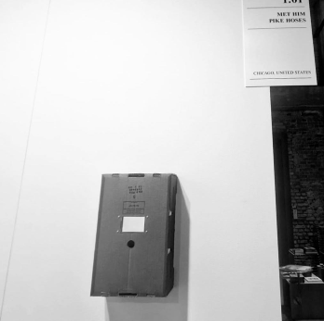
The First Script: Title Cards in Charlie Chaplin's The Kid (1921), 2026. The First Speech: Charlie Chaplin in The Great Dictator (1940), 2026. The Final Speech: Charlie Chaplin at the 44th Academy Awards (1972), 2026.
All three were built on the same principle: a 3.2-inch LCD screen and a Raspberry Pi Pico microcontroller embedded in a fruit shipping box, finished in pigment, lacquer, and birch plywood, each measuring 10 × 16 × 4 inches (25.4 × 40.64 × 10.16 cm), per the exhibition checklist.
As viewers approached, text formed on the screen word by word, turning reading into something drawn out — a sentence that resisted being taken in all at once.
Simon S. Belleau’s artworks reflect on the evolution of cinematic language while tracing significant turning points in Charlie Chaplin’s creative life. Simon S. Belleau creates a journey through Chaplin’s creative biography and the history of cinema’s development: from the written word, to the spoken word, to Chaplin’s public voice at the Academy Awards.
Particularly significant in this context is the work ‘’The First Speech’’, which references the film ‘’The Great Dictator’’ (1940). This film marks the moment when one of the most prominent silent-film artist showed his voice as a powerful artistic and political instrument. It should be noted that the film is a great example of political satire in the history of cinema. In it, Chaplin calls for humanity, freedom, and resistance to dictatorship, giving his voice not only artistic but also political significance. Even though more than 80 years have passed, aren’t some of these ideas still relevant today?